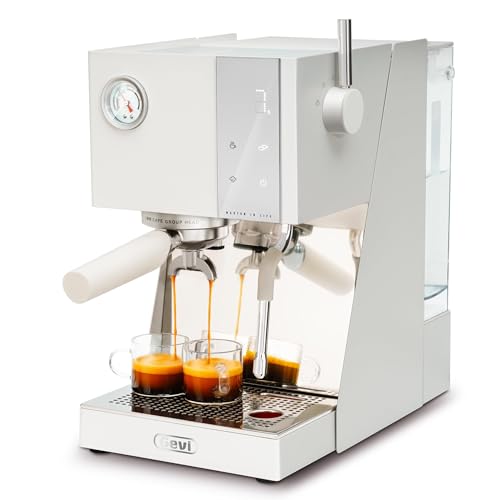
Gevi 20 Bar Espresso Machine With Steam Wand Review
4.5 / 5
Overall Rating
Gevi 20 Bar Espresso Machine with Steam Wand
Gevi's touchscreen espresso machine tracks pressure, temperature, and shot time live. Here is what the listing and specs actually say, including what is missing.
Check PriceWe may earn a commission if you make a purchase through our links.
Who the Gevi 20 Bar Espresso Machine With Steam Wand Is For
If you want a 58mm commercial-style portafilter and a screen that actually reports what your shot is doing while it pulls, the Gevi 20 Bar Espresso Machine with Steam Wand is worth a look. It suits someone upgrading from a pod machine or a basic pump machine who wants more feedback and control without jumping straight to a plumbed-in prosumer rig. It's a weaker match if a built-in grinder in the same box is a requirement, or if exact tank-capacity and dimension numbers matter before you buy, since Gevi's own listing doesn't publish those.
We did not test this product ourselves; this review is built from the manufacturer's published specifications and Amazon's product listing.
Gevi names this machine a "20 Bar" espresso machine, while the first feature bullet on Amazon's listing separately states it "operates at a stable, fixed 9-bar extraction pressure" during brewing. The listing doesn't explain how those two figures relate to each other — it never states that 20 bar is a pump maximum or that 9 bar is a regulated-down brewing pressure, even though that is a common pattern on other espresso machines. Treat the 9-bar figure as what the listing says reaches the coffee, and the "20 Bar" figure as the number in the product's own name, without assuming a specific mechanism connects them.
Key Specs, Per Amazon's Listing
| Spec | What the Listing States |
|---|---|
| Pump rating | 20-bar pump |
| Extraction pressure | Stable, fixed 9 bar during brewing |
| Temperature presets | Three: 92°C, 94°C, 96°C |
| Display | Touchscreen showing live pressure, water temperature, and shot time |
| Portafilter | Commercial 58mm, holds an 18-20g dose |
| Steam wand | "Super Steam" mode; continuous dry steam for microfoam |
| Warranty | 12 months plus lifetime technical support (official/authorized purchase channels only) |
| Water tank, dimensions, wattage | Not published in the listing data reviewed here |
Three temperature presets is the detail worth sitting with. Espresso extraction is sensitive to heat — a fruity light roast and an oily dark roast don't want identical water temperature — and the listing frames the 92/94/96°C presets as a way to match brew temperature to whatever bag of beans is in the hopper, rather than leaving a single fixed setting to cover everything.
What It Does Well, Per the Listing
The headline feature, per Gevi's own description, is the touchscreen that tracks pressure, temperature, and a shot timer together, instead of a needle gauge or no feedback at all. That matters because it's possible to see in real time whether a shot is running fast (under-extracted) or crawling (likely to taste bitter from over-extraction) and adjust grind size on the next pull.
The 58mm commercial portafilter matters for a related reason: a wider basket spreads an 18-20g dose across more surface area, which — per the listing's own framing — is meant to reduce channeling, where water punches through one weak spot in the puck instead of extracting evenly.
The steam wand is marketed as a "Super Steam" mode that produces continuous dry steam rather than a wetter, diluted stream — Gevi's stated reason it should texture milk into the kind of microfoam that holds together for latte art rather than just warming it. The warranty terms are concrete: 12 months of coverage plus lifetime technical support, though the listing is explicit that this applies only to machines bought through official or authorized channels — a detail worth double-checking with third-party marketplace resellers specifically.
Limitations and Who Should Skip It
No built-in grinder appears anywhere in the title or the six feature bullets reviewed here, which means this is a machine built around pre-ground espresso or beans ground separately — budget for a burr grinder if one isn't already on hand, since pre-ground coffee stales quickly and won't let the temperature presets or the touchscreen readout do much for the final cup.
The listing also leaves real gaps: no published water tank capacity, no machine dimensions, and no wattage figure in the data reviewed. If counter space or a small kitchen is a constraint, that's worth confirming before buying rather than assuming.
Shoppers mainly after a fully automatic, one-touch bean-to-cup machine — one that grinds, tamps, and pulls a shot at a single press — should look elsewhere. This is a semi-automatic machine that expects dosing, tamping, and, per the listing's framing, occasional grind-size adjustment based on what the touchscreen reports.
How It Compares
Against the Gaggia Classic Pro, which this site has also reviewed, the two machines share a 58mm portafilter size, and the Gaggia also carries two pressure numbers — but unlike the Gevi listing, Gaggia's own spec sheet explains the connection: a 15-bar Ulka pump with its OPV calibrated to a 9-bar brew pressure. The Gaggia offers nothing to look at beyond rocker switches and indicator lights — no pressure gauge, no temperature display, no shot timer. The Gevi's touchscreen is the clearest reason to choose it over the Gaggia if live feedback matters more than the simplicity of the Gaggia's single brass boiler and stainless-steel portafilter, per Gaggia's own spec sheet.
Against the De'Longhi Classic line of simpler pump machines, also reviewed on this site, the Gevi's touchscreen readout is the differentiator worth weighing — the Gevi listing doesn't benchmark extraction quality against any named competitor, so the practical choice between the two comes down to how much a live pressure, temperature, and shot-timer display is worth to you.
Check the current price on Amazon to see current availability, since listings and specs can change.
Getting the Most From the Temperature Presets
Per the listing, the three presets exist so a machine isn't brewing every bag of beans at identical water temperature. One general, widely-used starting convention in home espresso — not a Gevi-specific instruction — is to lean toward the lower end of a machine's temperature range for darker roasts, since lower temperatures tend to avoid pulling bitter, over-extracted flavor from oils that are already more developed from roasting, and toward the higher end for lighter roasts, which typically need more heat to extract fully. Watching the touchscreen's shot timer alongside this helps too: if a shot runs noticeably faster or slower than intended, adjusting grind size is the usual first move, before touching the temperature preset.
FAQ
Does the Gevi 20 Bar Espresso Machine have a built-in grinder?
Not per the listing data reviewed here. Amazon's feature bullets describe the pump, touchscreen, portafilter, steam wand, and warranty, but none mention a grinder, so plan on pre-ground espresso or a separate burr grinder.
What's the difference between the "20 bar" in the name and the "9 bar" in the features?
Amazon's listing doesn't say — the product name calls it a "20 Bar" machine, and a separate feature bullet states it "operates at a stable, fixed 9-bar extraction pressure," but the listing never explains how the two figures relate. Treat 9 bar as the pressure the listing says reaches the coffee during brewing.
Do the 92°C, 94°C, and 96°C presets matter if I only drink one kind of coffee?
They matter less if you stick to one roast style, but the listing frames them as a tool for matching brew temperature to different beans — useful if you rotate between light and dark roasts or switch coffee subscriptions often.
Is a 58mm portafilter harder to use than a smaller one?
Not inherently — it's a difference in dose size and surface area, not difficulty. A 58mm basket holds more coffee (the listing specifies 18-20g) and spreads it over a wider area; the listing frames that as reducing channeling, not as a harder basket to tamp.
Does this machine need special maintenance beyond a typical espresso machine?
The listing data reviewed here doesn't publish a specific maintenance schedule beyond the warranty terms, so check the documentation that ships with the unit, or Check the current price on Amazon and review the listing's own Q&A section for owner-reported maintenance notes before buying.
For more home-espresso picks across every price range, see our full shortlist.
Free Download
The First Brew Blueprint: 5-Gallon Amber Ale, Start to Sip
4 weeks from grain to glass
Instant download. No spam. Unsubscribe anytime.
Affiliate Disclosure
Discussion
Sign in with GitHub to leave a comment. Your replies are stored on this site's public discussion board.